
A person who uses force in Ontario may have a self-defence claim if they reasonably believed that they or someone else faced force or a threat of force, acted to protect against it, and responded reasonably in the circumstances. Courts look at what the person perceived, how the situation developed, and what options were realistically available. A confrontation can unfold in seconds, but the evidence may tell a story that began much earlier.
Self-defence laws in Ontario follow section 34 of the Criminal Code. Courts ask whether the person reasonably believed they or someone else faced force or a threat. They also consider whether the person acted to protect themselves or someone else. Finally, they decide whether the response was reasonable in the circumstances.
In R. v. Khill, the Supreme Court of Canada explained why a person’s actions before using force can matter. The case began with a fatal shooting near Hamilton. It shows why a court may look at how the confrontation developed before deciding whether the response was reasonable.
At the retrial in December 2022, the jury convicted Khill of manslaughter. In R. v. Khill, 2025 ONCA 146, the Ontario Court of Appeal dismissed his appeal against conviction. It reduced his sentence from eight years to six after fresh evidence revealed a sentencing error: the trial judge had intended to impose a six-year sentence. The Supreme Court dismissed Khill’s application for leave to appeal on July 31, 2025.
Read the later Ontario Court of Appeal decision: R. v. Khill, 2025 ONCA 146 (CanLII)
What happened in the Khill case
Early one morning in February 2016, Peter Khill’s partner woke him after hearing a noise outside their home near Hamilton. Khill saw the dashboard lights on in his pickup truck. He loaded a shotgun, went outside, and approached the truck. He saw Jonathan Styres leaning into the open passenger door. Khill shouted; Styres turned, and Khill fired twice, killing him. Khill testified that he believed Styres was armed and about to shoot him. Styres had no gun.
The first jury acquitted Khill of second-degree murder. The Ontario Court of Appeal overturned the acquittal and ordered a new trial. In 2021, the Supreme Court upheld that order. The trial judge had given the jury some guidance on self-defence but had failed to explain how Khill’s own actions during the incident could affect its assessment of whether the shooting was reasonable. The Supreme Court’s ruling addressed the jury instructions. The retrial jury determined the verdict.
At the retrial in December 2022, the jury convicted Khill of manslaughter. In R. v. Khill, 2025 ONCA 146, the Ontario Court of Appeal upheld that conviction and reduced the sentence from eight years to six. The Supreme Court dismissed his application for leave to appeal on July 31, 2025.
The three questions courts ask under section 34
Section 34 of Canada’s Criminal Code applies in Ontario. It sets out three requirements for self-defence, including when someone acts to protect another person.
- Did the person reasonably believe there was a threat or use of force? A court considers what the person actually believed and whether the circumstances gave them reasonable grounds for that belief. A mistaken perception can still support the defence if the evidence gives a reasonable basis for it. Lighting, distance, words, and movements can help explain what the person thought was happening.
- Did the person act to protect themselves or someone else? The court examines the person’s purpose when they used force. For example, pushing someone away to stop an attack points to a protective purpose. Going after the person once the danger has passed may support a different inference.
- Was the response reasonable in the circumstances? The court looks at the nature and urgency of the threat, whether anyone used or threatened to use a weapon, what alternatives were available, and how the response compared with the threat. The person’s own role in the incident can also affect that assessment.
Why the moments before force was used matter
In Khill, the jury needed to consider more than what Khill saw when Styres turned. It also needed guidance on how to assess Khill’s decision to load a shotgun, leave the house, and approach the truck in the dark. The Supreme Court explained that earlier conduct matters when it helps the jury decide whether the eventual use of force was reasonable. The court could consider whether those choices contributed to the confrontation and what options were available at each point.
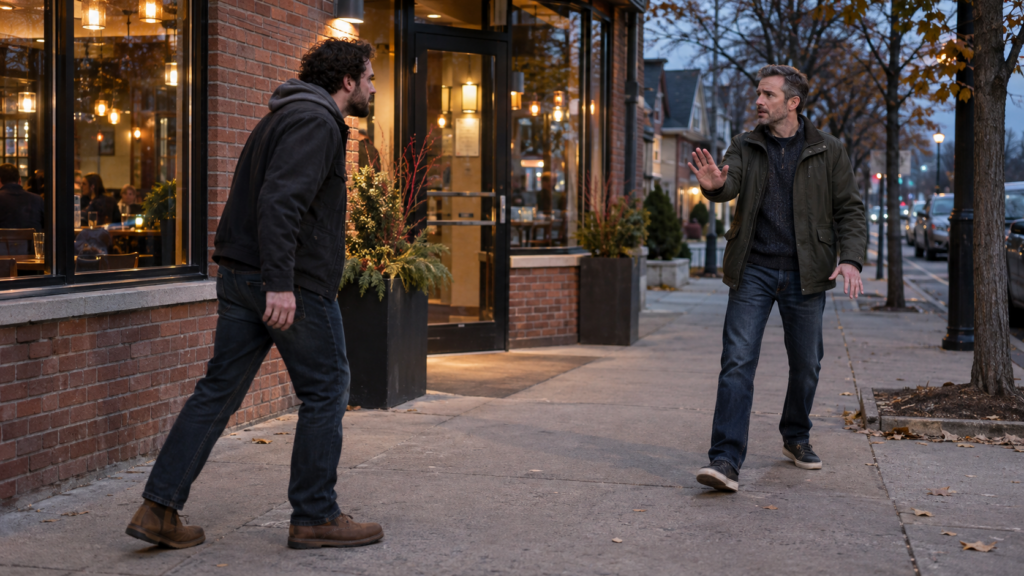
Consider a less serious example. Two people argue outside a restaurant. One steps forward with a raised fist and the other pushes them away. If the first person then backs off and the second follows and strikes them, the evidence may support different conclusions about the push and the later strike. The distance between the people, the time between the acts, and whether the threat continued could all matter. A recording that starts late may show the strike while leaving the first encounter out of view.
Whether someone has to walk away first
Available alternatives are one factor in deciding whether force was reasonable under section 34. There is no categorical requirement to retreat in every case, but a court may ask whether the person could safely step back, leave, call for help or take other realistic steps. The urgency of the threat and practical options at the time matter.
When the incident starts with a break-in
A break-in can raise separate questions about defence of a person under section 34 and defence of property under section 35. In Khill, the defence relied on his claimed belief that he faced an armed threat. Interference with property does not, by itself, automatically justify deadly force. The purpose of the response and all the circumstances determine which legal test applies.
What a criminal lawyer in Brampton can review
If you face an assault charge and believe you acted to protect yourself or someone else, a criminal lawyer in Brampton can review the sequence of events against the Crown’s evidence. Relevant material may include security footage, witness accounts, messages, photographs, medical records, and emergency call recordings. The timing can matter as much as the material itself. A message sent before the confrontation may explain why someone feared a threat. Footage from a second camera may show whether there was room to move away or whether the other person kept advancing. Criminal Defence Lawyer in Brampton.
Brij Mohan & Associates represents people facing assault and other criminal allegations in Brampton and across the GTA. If a charge arose after you used force to protect yourself or someone else, you can speak with our Brampton office about the circumstances and the evidence available. Call 416-994-8989 or request a confidential consultation.
This article provides general information. Legal advice depends on the facts of your case.